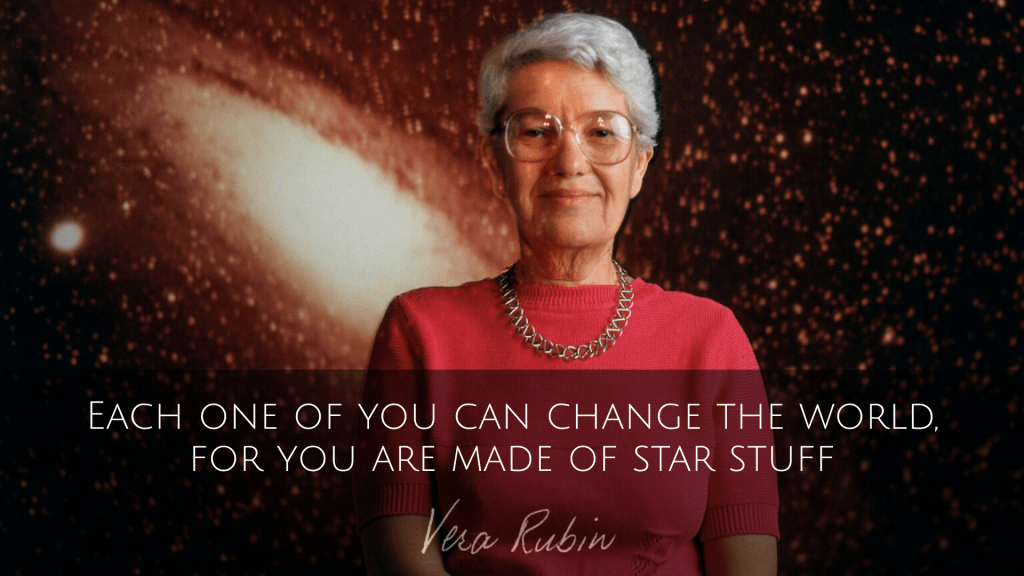
About Vera Rubin
Dr. Vera C. Rubin was an American astrophysicist whose groundbreaking work revolutionized our understanding of the cosmos. Born in Philadelpha in 1928, Dr. Rubin developed a love of astronomy after moving to a new home in Washington D.C. With the help of her father, Rubin built a telescope to better see the stars outside her window. This passion would see her become a pioneer in the male-dominated field of astronomy and help unravel some of the greatest mysteries of the universe.
In the 1970s, Dr. Rubin made a profound discovery that challenged existing theories: galaxies didn’t rotate as expected based on visible matter alone. Rubin’s observations provided some of the strongest evidence of the existence of dark matter, an invisible substance that exerts gravitational forces and significantly shapes the large-scale structure of the universe.
Dr. Rubin’s perseverance and contributions earned her numerous accolades. In 1993, she became just the second female astronomer to be elected to the National Academy of Sciences. Rubin’s work paved the way for further exploration into the mysterious realms of dark matter, influenced generations of scientists, and inspired a new era of research in astrophysics.
About Dark Matter
Dark matter remains one of the biggest enigmas in the universe. Undetectable by conventional telescopes, scientists can only infer its existence through the gravitational effects it has on visible matter. The invisible force from dark matter plays a crucial role in orchestrating the motion and cohesion of galaxies, steering their rotations and gravitational interactions.
Based on current astronomical observations, dark matter makes up approximately 85% of the universe’s total mass–6x what we can directly observe! While the precise composition of dark matter remains unknown, the study of its gravitational effects provides valuable insights into the fundamental structure and dynamics of the universe.
Bonus Image
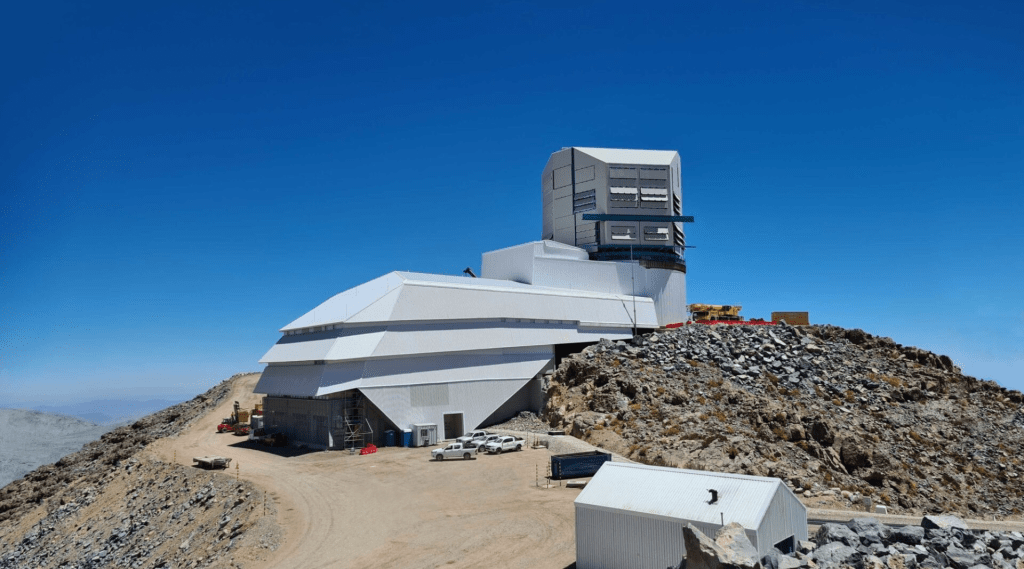
The Vera C. Rubin Observatory is currently under construction on the Cerro Pachón ridge in Chile. Once completed in 2025, it will begin it’s mission of capturing daily images of the universe as part of the Legacy Survey of Space and Time. The scope and ambition of this undertaking is remarkable:
Every night for a decade, Rubin Observatory will take images of the sky using a 3200 megapixel camera and six different optical filters. Each image covers an area as big as 40 full moons, and the giant 8.4-meter telescope can move between different positions in less than five seconds. In this way, the telescope will image the entire visible sky every 3-4 nights. This makes Rubin Observatory particularly good at detecting objects that have changed in brightness, like supernovae, or in position, like asteroids. Additionally, Rubin Observatory’s light-collecting power and sensitive camera will help us discover about 20 billion galaxies and a similar number of stars.
Don’t take my word for it! Learn more at https://rubinobservatory.org/.
 JASON KAVENEY
Leave a comment